

Advanced Turbinate Reduction - Advanced Nasal Care
Do you struggle with a constantly blocked nose? Or perhaps nasal sprays no longer provide relief. Turbinate Reduction is the effective long-term solution. It shrinks the swollen structures inside your nose. At Sinocare, we perform Turbinate Reduction to clear your airway instantly. Furthermore, this procedure preserves the natural function of your nose. Medications often fail to treat chronic swelling permanently. Therefore, a minor correction becomes necessary. Ultimately, Turbinate Reduction restores effortless breathing day and night.
What is Tonsillectomy?
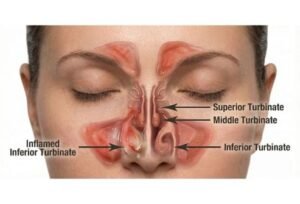
Turbinate Reduction (also called Inferior Turbinate Reduction) is a surgical procedure performed to reduce the size of the nasal turbinates — structures inside the nose that help filter, warm, and humidify the air we breathe.
When these turbinates become chronically enlarged (hypertrophied) due to allergies, infections, or a deviated septum, they can block airflow and cause nasal congestion, snoring, or breathing difficulties.
Therefore, the surgery aims to shrink swollen tissue while preserving the natural function of the turbinates.
Goal: It creates more space for air. Consequently, nasal resistance drops significantly.
Procedure: We remove excess soft tissue or bone. Thus, the airway widens.
Duration: Typically, the procedure takes between 20 to 30 minutes.
Target Patients: Doctors recommend this for chronic rhinitis or nasal obstruction.
Hospitalization: It is usually a day-care procedure. Therefore, you go home the same day.
Purpose of the Surgery
Turbinate Reduction is recommended when medical treatments such as nasal sprays, antihistamines, or decongestants fail to relieve chronic nasal blockage.
Chronic Congestion: It relieves the feeling of a “stuffed” nose. Specifically, it treats hypertrophy (enlargement).
Medication Dependence: It reduces the need for daily nasal sprays.
Sleep Quality: It stops night-time blockage. Therefore, you sleep deeper.
Snoring Relief: It opens the nasal passage. Consequently, snoring vibration decreases.
Sinus Drainage: It improves airflow near sinus openings. Thus, infections occur less often.
Is Turbinate Reduction invasive?
Yes, modern Turbinate Reduction is highly minimally invasive.
No External Cuts: We perform everything through the nostrils. Therefore, your face remains scar-free.
Mucosa Preservation: We save the outer lining of the turbinate. Consequently, the nose functions normally afterward.
Coblation Tech: We use radiofrequency energy. Thus, there is no burning or cutting of healthy tissue.
Less Bleeding: The technology seals blood vessels instantly.
Rapid Recovery: Most patients return to work in 2–3 days.
Instruments and Technology used in Turbinate Reduction
Turbinate Reduction is a common surgical procedure performed to decrease the size of enlarged nasal turbinates (most often the inferior turbinate) to improve nasal airflow and relieve obstruction. Specifically, the instruments and technology used are focused on reducing the size of the turbinate tissue while minimizing damage to the overlying mucosa to preserve normal nasal function.
1. Visualization Tools:
Nasal Endoscopes: High-definition cameras. They show the exact amount of swelling.
Monitors: The surgeon views the airway on a magnified screen.
2. Removal Technologies:
Coblation Wand: A device using plasma energy. It shrinks tissue without heat damage.
Microdebrider: A powered shaver. It removes internal bulk while saving the surface skin.
Radiofrequency Probes: These deliver energy to stiffen and shrink loose tissue.
Advanced Equipments and Their Benefits
Using the right equipment ensures long-term results. Here is why we use specialized tools for Turbinate Reduction:
1. Microdebrider System (Submucosal Resection)
What it is: A powered tool with a hollow rotating tip.
The Benefit:
Preservation: It removes the “stuffing” inside the turbinate but leaves the outer skin intact. Therefore, the nose creates mucus normally.
Precision: It targets only the swollen area. Consequently, healing is extremely fast.
2. Coblation Technology (Cold Ablation)
What it is: A wand that uses saline and radiofrequency to dissolve tissue at low temperatures (40°C-70°C).
The Benefit:
Painless: It does not burn the tissue like old-fashioned cautery. Therefore, post-op pain is minimal.
Safety: It prevents crusting and dryness. Thus, recovery is comfortable.
3. High-Definition Endoscopes
What it is: 4mm rigid cameras inserted into the nose.
The Benefit:
Accuracy: We see the entire length of the turbinate. Therefore, we treat the back part (tail) which often causes blockage.
Post-Surgery Experience
After Turbinate reduction patients may experience mild nasal congestion, slight bleeding, or a blocked feeling in the nose for a few days. These symptoms are temporary and improve as healing progresses.
Immediate Aftermath: You will feel congested for a few days. This is due to internal swelling.
Crusting: Minor crusts may form. However, saline sprays clear them easily.
No Packing: We rarely use tight nasal packing. Therefore, you breathe comfortably immediately.
Bleeding: Minor spotting is normal for 24 hours.
Timeline: Breathing improves dramatically after week 1. Eventually, full results appear by week 3.
Understanding the Risks
Turbinate reduction is a safe and minimally invasive procedure, but as with any surgery, a few risks may occur, such as:
Dryness: Removing too much tissue causes dryness. However, our submucosal technique prevents this.
Bleeding: Minor nosebleeds can occur.
Crusting: Temporary scabs may form inside the nose.
Empty Nose Syndrome: A rare condition where the nose feels too open. We avoid this by preserving the turbinate structure.
Regrowth: Tissue may swell again after years if allergies persist.
Tonsillectomy Surgery – FAQs
Is Tonsillectomy painful?
Some discomfort is expected for about a week, but pain is well-managed with medications and proper care. Most patients tolerate it well.
What foods can I eat after surgery?
Soft and cool foods like yogurt, mashed potatoes, custard, and ice cream are best. Avoid spicy, crunchy, or acidic foods until recovery.
Will my immunity decrease after tonsil removal?
No, the body has other immune tissues that take over the function of the tonsils. Immunity remains strong and unaffected.
How long should I take rest after tonsillectomy?
Children usually need 7–10 days of rest, while adults may take 10–14 days before returning to normal activities.
Can tonsils grow back after removal?
In rare cases, tiny remnants may regrow partially, but they typically do not cause any health issues.
Is bleeding normal after surgery?
A few spots of blood in saliva are normal. However, if there is continuous or fresh bleeding, immediate medical attention is required.
When can I start speaking normally again?
You can talk softly after a few hours, but avoid shouting or straining your voice for about a week to allow proper healing.
Will tonsillectomy cure snoring or sleep apnea?
If enlarged tonsils were the main cause of airway obstruction, tonsillectomy can significantly improve or completely resolve snoring and sleep apnea symptoms.
Book An Appointment
We believe that communication should always be easy and stress-free. You can reach Sinocare ENT using any of the following methods: