

Mastoidectomy Surgery - Advanced Ear Care
Do you suffer from persistent ear discharge? Or perhaps chronic ear infections refuse to heal. Mastoidectomy Surgery is the definitive solution for these complex issues. This procedure cleans out the infected bone behind the ear. At Sinocare, we specialize in advanced Mastoidectomy Surgery to stop the infection from spreading. Furthermore, this operation protects your hearing from further damage. Medications often fail to clear deep bone infections. Therefore, surgery becomes necessary to create a safe, dry ear. Ultimately, Mastoidectomy Surgery prevents dangerous complications like meningitis or facial paralysis.
What is Mastoidectomy Surgery?
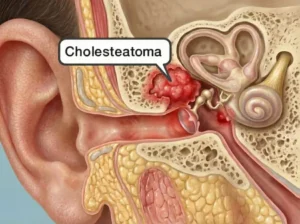
Surgeons perform Mastoidectomy Surgery to remove diseased air cells within the mastoid bone. This bony area sits directly behind the ear. Since the mastoid connects to the middle ear, chronic infections or cholesteatoma often spread here. During the surgery, the ENT surgeon carefully removes infected tissue. As a result, they prevent complications and restore ear health. Thus, Mastoidectomy Surgery helps eliminate infection, preserve hearing, and prevent further damage.
The Goal: It eliminates chronic infection. Consequently, it creates a safe environment inside the ear.
The Procedure: We access the bone behind the ear. Then, we drill away diseased tissue.
Duration: Typically, the surgery takes between 2 to 3 hours.
Target Patients: Doctors perform this on patients with Cholesteatoma or unsafe ear infections.
Hospitalization: It usually requires a 1-day hospital stay. Therefore, observation is necessary.
The Goal: It eliminates chronic infection. Consequently, it creates a safe environment inside the ear.
The Procedure: We access the bone behind the ear. Then, we drill away diseased tissue.
Duration: Typically, the surgery takes between 2 to 3 hours.
Target Patients: Doctors perform this on patients with Cholesteatoma or unsafe ear infections.
Hospitalization: It usually requires a 1-day hospital stay. Therefore, observation is necessary.
Purpose of the Surgery
Doctors recommend Mastoidectomy Surgery when infection spreads into the bone. The primary goal is safety.
Cholesteatoma: It removes this destructive skin cyst. Specifically, this cyst eats away ear bones.
Chronic Otitis Media: It treats long-standing infections. Otherwise, discharge never stops.
Complication Prevention: It stops infection from reaching the brain or facial nerve.
Hearing Preservation: It halts damage to the hearing mechanism.
Implant Preparation: Sometimes, we do it to prepare for a Cochlear Implant.
Is Mastoidectomy minimally invasive?
Mastoidectomy Surgery is not fully minimally invasive like FESS. However, modern techniques have improved significantly.
Hidden Incision: We make the cut behind the ear. Therefore, the scar is well-hidden in the hairline.
Endoscopic Assistance: We use endoscopes to see around corners. Consequently, we drill less bone than before.
Precision: High-speed drills work with millimeter accuracy.
Preservation: We spare healthy structures. Thus, recovery is faster than with older methods.
Less Trauma: Advanced microscopes allow us to work through smaller openings.
Instruments and Technology used in Mastoidectomy Surgery?
Mastoidectomy Surgery requires extreme precision. We work millimeters away from the brain and facial nerve.
1. Visualization Tools:
Operating Microscope: This provides 3D magnification. It is crucial for seeing tiny ear structures.
Endoscopes: These help us see “around the corner” in hidden areas.
2. Drilling Systems:
High-Speed Otologic Drill: It spins at 80,000 RPM. Therefore, it powders bone effortlessly without pressure.
Diamond Burrs: These polish the bone near nerves. Thus, they prevent injury.
3. Monitoring Systems
- Facial Nerve Monitor: It tracks nerve activity. Consequently, it warns the surgeon if they get too close to the nerve.
Advanced Equipments and Their Benefits
Using the right technology is vital for safety. Here is why we use specific tools for Mastoidectomy Surgery:
1. High-Resolution Operating Microscope
What it is: A powerful microscope that magnifies the surgical field up to 40 times.
The Benefit:
Safety: It allows the surgeon to see the facial nerve clearly. Therefore, accidental injury is avoided.
Precision: We can completely remove microscopic disease. Thus, the risk of recurrence drops significantly.
2. Intraoperative Facial Nerve Monitor
What it is: A device with electrodes placed on the face that “listens” to the facial nerve during surgery.
The Benefit:
Early Warning: It beeps if the drill comes near the nerve. Consequently, the surgeon alters their path immediately.
Peace of Mind: It dramatically reduces the risk of facial paralysis.
3. High-Speed Skeeter Drill
What it is: A specialized drill designed for delicate ear surgery.
The Benefit:
Control: It removes hard bone without vibration. Therefore, the delicate hearing bones are not jarred or damaged.
Speed: It reduces surgical time. As a result, you spend less time under anesthesia.
Post-Surgery Experience
Recovery from Mastoidectomy Surgery is steady.
Immediate Aftermath: You will have a bandage around your head. This stays for 24–48 hours.
Dizziness: Mild dizziness is common for a day or two. However, it passes quickly.
Stitches: We usually remove stitches behind the ear after 7 days.
Water Precautions: You must keep the ear dry. Therefore, use cotton with vaseline while bathing.
Timeline: Most people return to work in 1 week. Eventually, the ear heals fully in 4–6 weeks.
Understanding the Risks
Mastoidectomy Surgery is complex but safe in expert hands. Nevertheless, you should know the risks:
Facial Weakness: Temporary weakness of the face can occur. However, permanent injury is extremely rare with monitoring.
Hearing Change: Hearing may temporarily drop due to packing.
Taste Disturbance: You might feel a metallic taste. This usually fades over time.
Tinnitus: Ringing in the ear may persist.
Infection: Rare wound infections can happen. However, antibiotics prevent this.
Mastoidectomy Surgery – FAQs
Is Mastoidectomy a painful procedure?
No, the surgery is done under general anesthesia, so you won’t feel pain. Mild discomfort or soreness may occur afterward and can be managed with medication.
How long does it take to recover?
Most patients recover within 2–3 weeks. Complete healing of the ear may take a few months depending on the extent of the surgery.
Will my hearing improve after the surgery?
Hearing improvement depends on the underlying condition and the extent of middle ear involvement. In many cases, hearing improves once infection is cleared.
Will I have a scar after mastoidectomy?
The incision is usually made behind the ear and heals well, leaving a faint or hidden scar.
Can infection come back after surgery?
Recurrence is rare when the disease is completely removed and postoperative instructions are properly followed.
When can I resume normal activities?
Light activities can be resumed after a week, but avoid swimming, air travel, and strenuous exercise for at least 3–4 weeks.
Is Mastoidectomy performed alone or with tympanoplasty?
In many cases, Mastoidectomy is combined with tympanoplasty to repair the eardrum and restore hearing.
How long does the dressing stay after surgery?
The dressing is usually removed after 24–48 hours, and the ear canal packing is taken out after about a week during a follow-up visit.
Book An Appointment
We believe that communication should always be easy and stress-free. You can reach Sinocare ENT using any of the following methods: