
Advanced Thyroidectomy Surgery - Advanced Thyroid Care
Do you have a visible lump in your neck? Or perhaps your hormone levels are fluctuating dangerously. Thyroidectomy Surgery is the primary treatment for these issues. It involves removing part or all of the thyroid gland. At Sinocare, we perform Thyroidectomy Surgery with extreme precision. Furthermore, we prioritize protecting your voice. Medication often cannot shrink large goiters. Therefore, surgical removal provides a permanent fix. Ultimately, Thyroidectomy Surgery safeguards your long-term health.
What is Thyroidectomy?
Thyroidectomy is a surgical procedure performed to remove all or part of the thyroid gland — a butterfly-shaped gland located in the front of the neck that regulates metabolism, heart rate, and body temperature.
The surgery may involve total thyroidectomy (removal of the entire gland) or partial thyroidectomy (removal of one lobe). It is commonly done to treat thyroid nodules, goiters, overactive thyroid (hyperthyroidism), or thyroid cancer. With modern techniques, the surgery is safe, precise, and results in minimal scarring.
The Goal: It treats structural or hormonal problems. Consequently, health risks like cancer or compression are eliminated.
The Procedure: Surgeons perform this under general anesthesia. Thus, you sleep through the entire operation.
Duration: Typically, the surgery takes between 2 to 3 hours.
Target Patients: Doctors recommend this for thyroid cancer, large goiters, or hyperthyroidism.
Hospitalization: It usually requires a 1 to 2-day hospital stay. Therefore, we monitor calcium levels closely.
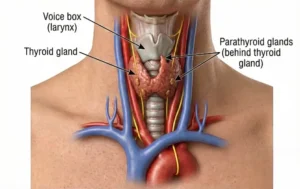
Purpose of the Surgery
Thyroidectomy Surgery is recommended for several thyroid-related conditions that cannot be managed effectively through medication or other therapies. Common reasons include:
Thyroid Cancer: It removes malignant cells. Specifically, this prevents the disease from spreading.
Goiter Removal: It removes enlarged glands that block breathing. Therefore, swallowing becomes easier.
Hyperthyroidism: It treats Graves’ disease. Consequently, hormone levels stabilize permanently.
Suspicious Nodules: It removes lumps that might be cancerous.
Cosmetic Relief: It removes unsightly neck swelling.
Is Thyroidectomy minimally invasive?
Yes, modern Thyroidectomy Surgery can be minimally invasive.
MIVAT Technique: We use the Minimally Invasive Video-Assisted Thyroidectomy method. Therefore, the incision is very small (2-3 cm).
Hidden Scars: We place incisions in natural skin creases. Consequently, the scar is barely visible.
Endoscopic Aid: We use cameras to see clearly. Thus, tissue trauma is reduced.
Harmonic Technology: We use ultrasonic energy to cut. Therefore, bleeding is minimal.
Fast Recovery: Most patients talk and eat the same evening.
Instruments and Technology used in Thyroidectomy Surgery
Thyroidectomy Surgery involves precise removal of thyroid tissue while preserving the recurrent laryngeal nerves and parathyroid glands. Instrumentation focuses on safe dissection, visualization, and hemostasis.
1. Visualization Tools:
Surgical Loupes: These are magnifying glasses worn by the surgeon. They make nerves look larger.
Endoscopes: These provide a bright view for minimally invasive approaches.
2. Cutting Instruments:
Harmonic Scalpel: A device that uses sound waves. It cuts and seals blood vessels simultaneously.
Bipolar Cautery: It stops bleeding instantly with precision.
3. Monitoring Systems:
- Nerve Integrity Monitor (NIM): A system that “listens” to the vocal cord nerves. Therefore, we avoid accidental injury.
3. Robotic and Endoscopic Technology (Remote-Access Surgery):
Robotic System (e.g., da Vinci): This advanced platform uses a console operated by the surgeon to manipulate long, wristed endoscopic instruments inserted through small incisions remote from the neck.
Endowrist Instruments: These specialized robotic tools provide seven degrees of freedom, mimicking the movement of a human wrist within the patient’s body, allowing for precise, delicate manipulation and dissection deep within the surgical field.
3D Camera System: The robotic system provides the surgeon with a high-definition, magnified 3D view of the anatomy, compensating for the lack of direct visualization.
Endoscopic Instruments: For non-robotic endoscopic approaches, specially long-shafted, rigid endoscopic instruments and trocars (sleeves) are used to create and work within the remote surgical space.
Advanced Equipments and Their Benefits
Using the right technology protects your voice. Here is why we use specialized tools for Thyroidectomy Surgery:
1. Intraoperative Nerve Monitor (NIM)
What it is: A specialized tube with electrodes placed in the throat.
The Benefit:
Voice Safety: It beeps if the surgeon gets too close to the Recurrent Laryngeal Nerve. Therefore, voice changes are prevented.
Confidence: It helps identify nerves even in difficult, scarred cases.
2. Harmonic Scalpel (Ultrasonic Dissector)
What it is: A surgical instrument that vibrates at high frequency.
The Benefit:
Bloodless Surgery: It seals vessels up to 5mm wide. Consequently, the surgical field stays dry.
Speed: It cuts and seals in one step. Thus, anesthesia time is shorter.
No Foreign Body: We use fewer internal stitches. Therefore, tissue reaction is less.
3. Magnifying Loupes
What it is: High-power glasses worn by the surgeon.
The Benefit:
Precision: It allows us to save the tiny Parathyroid glands. These control your calcium levels.
4. Robotic Surgical System
What it is: An advanced platform where the surgeon controls precise robotic arms from a console, operating through incisions made away from the neck (like the underarm).
The Benefit:
No Neck Scar: It allows for “scarless” neck surgery by hiding the incision in a remote location.
Stability: It filters out hand tremors. Therefore, the surgery is performed with absolute steadiness.
5. Endowrist Instruments
What it is: Specialized robotic tools that bend and rotate with seven degrees of freedom, mimicking and exceeding the movement of the human wrist.
The Benefit:
Dexterity: They allow the surgeon to reach deep, narrow spaces that rigid tools cannot reach.
Precision: Consequently, delicate dissection around nerves is safer and more accurate.
6. 3D Camera System
What it is: A high-definition vision system that provides the surgeon with a magnified, three-dimensional view of the anatomy.
The Benefit:
Depth Perception: Unlike standard 2D screens, this allows the surgeon to judge depth perfectly.
Safety: Thus, vital structures like the laryngeal nerve are easily identified and protected.
7. Endoscopic Instruments
What it is: Long, slender, rigid instruments and trocars (sleeves) used to create a working space and operate through small “keyhole” ports.
The Benefit:
Minimally Invasive: They enable surgery without large open incisions.
Faster Recovery: Therefore, tissue trauma is reduced, leading to less pain and a quicker return to normal activities.
Post-Surgery Experience
After Thyroidectomy Surgery, patients may experience mild neck discomfort, soreness while swallowing, or temporary voice changes. Most can start speaking and eating soft foods within hours.
Immediate Aftermath: You will have a sore throat. This is normal.
Voice Check: We check your voice immediately after waking up.
Drain Tube: Occasionally, a small tube drains fluid for 24 hours.
Calcium Check: We monitor calcium levels closely. Therefore, you might take calcium tablets temporarily.
Scar Care: The scar fades significantly over 6 months.
Understanding the Risks
Thyroidectomy Surgery is a safe and commonly performed procedure, but like any surgery, it carries some potential risks, including:
Voice Changes: Hoarseness can occur. However, permanent voice loss is extremely rare with monitoring.
Hypocalcemia: Low calcium levels may cause tingling. This is usually temporary.
Bleeding: A neck hematoma is a rare complication.
Infection: Wound infections are very uncommon.
Hypothyroidism: If the whole gland is removed, you must take a daily hormone pill for life.
Thyroidectomy Surgery – FAQs
Is Thyroidectomy a major surgery?
Yes, but it is considered a routine and safe procedure when performed by an experienced surgeon. Most patients recover quickly.
How long will I stay in the hospital?
Many patients are discharged within 24–48 hours after surgery, depending on the extent of thyroid removal and recovery.
Will I have a visible scar?
The incision is usually made in a natural neck crease, and the scar fades over time. Some modern procedures use minimally invasive or endoscopic techniques for smaller scars.
Will I need to take thyroid medicine after surgery?
If the entire thyroid is removed, lifelong thyroid hormone replacement will be needed to maintain normal metabolism.
Can Thyroidectomy affect my voice?
Temporary voice changes may occur due to nerve irritation but usually resolve within a few weeks. Permanent changes are rare.
How soon can I return to normal activities?
Most patients can return to work and light activities within a week, but strenuous exercise should be avoided for 2–3 weeks.
Will removing the thyroid affect calcium levels?
Sometimes, calcium levels may drop temporarily if nearby parathyroid glands are disturbed. Supplements may be prescribed if needed.
How often should I follow up after surgery?
Follow-up visits are recommended 1–2 weeks after surgery, then periodically to check hormone and calcium levels, and to adjust medication if required.
Book An Appointment
We believe that communication should always be easy and stress-free. You can reach Sinocare ENT using any of the following methods: