
Advanced Stapedotomy Surgery
Do you have trouble hearing in low-noise environments? Or perhaps you suffer from a condition called Otosclerosis. Stapedotomy Surgery is the gold standard treatment. It restores hearing by replacing a tiny fixed bone in the ear. At Sinocare, we specialize in Stapedotomy Surgery to bring back sound clarity. Furthermore, this procedure uses microscopic precision. Hearing aids are not your only option. Therefore, surgical correction offers a permanent solution. Ultimately, Stapedotomy Surgery reconnects you with the world of sound.
What is Stapedotomy Surgery?
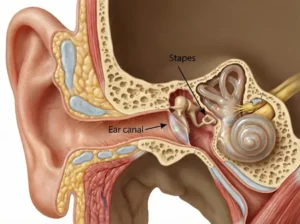
Stapedotomy Surgery is a precise ear procedure. Specifically, it improves hearing in patients with otosclerosis. This is a condition where the stapes bone becomes fixed. Consequently, it cannot vibrate properly. Because of this fixation, sound waves do not reach the inner ear effectively. As a result, patients suffer from hearing loss.
During Stapedotomy Surgery, the surgeon removes part of the immobile stapes bone. Then, they replace it with a small prosthesis. Effectively, this transmits sound vibrations to the inner ear. Furthermore, it offers excellent improvement in hearing for most patients.
The Goal: It bypasses the fixed bone. Consequently, sound vibrations reach the inner ear again.
The Procedure: Surgeons perform it entirely through the ear canal. Thus, no external cuts are visible.
Duration: Typically, the surgery takes between 45 to 60 minutes.
Target Patients: Doctors recommend this for patients with conductive hearing loss due to Otosclerosis.
Hospitalization: It is usually a day-care procedure. Therefore, you go home the same day.
Purpose of the Surgery
Doctors recommend Stapedotomy Surgery primarily for patients with otosclerosis. These patients experience conductive hearing loss. In this state, sound stops passing efficiently through the middle ear.
Otosclerosis Treatment: It fixes the root cause of bone fixation. Specifically, this allows sound to travel freely.
Better Clarity: It improves high-frequency hearing. Therefore, speech becomes clearer than with hearing aids.
Permanent Solution: The prosthesis stays in place for life.
Tinnitus Relief: It often reduces the ringing sound associated with hearing loss.
Binaural Hearing: It helps balance hearing when done (sequentially) on both ears.
Is Stapedotomy Surgery minimally invasive?
Yes, Stapedotomy Surgery is highly minimally invasive.
Transcanal Approach: We work through the natural ear canal. Therefore, there are no external scars.
Microscopic Incision: The hole made in the footplate is less than 0.8 millimeters.
Tissue Preservation: We leave the tendon and muscle intact. Thus, recovery is faster.
Laser Precision: We often use lasers to vaporize bone. Consequently, trauma is minimal.
Quick Recovery: Most patients return to normal life within a few days.
Instruments and Technology used in Stapedotomy Surgery
Stapedotomy Surgery requires the highest level of precision. We use advanced microsurgical tools.
1. Visualization Tools:
High-Powered Microscope: It magnifies the tiny stapes bone up to 20 times.
Endoscopes: These help verify the prosthesis position from different angles.
2. Perforation Tools:
Micro-Drill: A tiny drill bit used to penetrate thick bone safely.
Laser (CO2 or KTP): A beam of light that creates a precise hole without vibration.
3. Implants:
- Teflon or Titanium Piston: A lightweight prosthesis. It mimics the natural movement of the stapes.
Advanced Equipments and Their Benefits
Using the right technology ensures success. Here is why we use specialized tools for Stapedotomy Surgery:
1. CO2 Laser System
What it is: A “no-touch” cutting tool that uses light energy.
The Benefit:
Safety: It vaporizes bone without touching it. Therefore, there is zero vibration transmitted to the inner ear.
Precision: The hole size is exact (0.6mm). Thus, the piston fits perfectly.
2. Teflon-Platinum Prosthesis
What it is: A modern implant made of biocompatible materials.
The Benefit:
Lightweight: It moves effortlessly with sound waves. Consequently, hearing quality is natural.
MRI Safe: It is safe for future MRI scans. Therefore, you have no medical restrictions.
3. Facial Nerve Monitor
What it is: A safety device that tracks the nearby facial nerve.
The Benefit:
Protection: It warns the surgeon if they get too close to the nerve. Thus, facial weakness is prevented.
Post-Surgery Experience
Recovery from Stapedotomy Surgery requires patience.
Immediate Aftermath: You may feel dizzy for a few hours. This is normal.
Hearing Status: Hearing improves once the packing is removed (1 week).
Taste Changes: You might notice a metallic taste. However, this fades in a few weeks.
Water Precautions: You must keep the ear dry. Therefore, use cotton with Vaseline while bathing.
Activity: Avoid air travel and heavy lifting for 3 weeks. This protects the new piston.
Understanding the Risks
Stapedotomy Surgery has a high success rate. Nevertheless, minor risks exist:
Dizziness: Vertigo can last for a few days. However, medication helps.
Hearing Loss: There is a tiny risk (<1%) of hearing loss in the operated ear.
Tinnitus: Ringing may persist in some cases.
Taste Disturbance: The nerve for taste runs near the stapes. Temporary changes can occur.
Perforation: A hole in the eardrum is rare but fixable.
Throat Surgery – FAQs
How is stapedotomy different from stapedectomy?
In stapedotomy, only a small hole is made in the stapes footplate, while in stapedectomy, the entire stapes is removed. Stapedotomy is less invasive and has better long-term outcomes.
How long will it take to notice hearing improvement?
Most patients experience better hearing within 2–4 weeks after surgery, once the ear heals and packing is removed.
Will I need to stay in the hospital?
It is usually a day-care or overnight procedure. You can go home the same or next day.
Can otosclerosis affect both ears?
Yes, it often affects both ears. Surgery is usually performed on the worse ear first, followed by the other ear after full recovery if needed.
Is the prosthesis permanent?
Yes, the prosthesis used in stapedotomy is designed to last a lifetime and rarely needs replacement.
Will I experience pain after surgery?
Mild discomfort or pressure is common, but severe pain is rare and usually resolves within a few days.
Can hearing loss return after stapedotomy?
Hearing improvement is long-lasting, though in some rare cases, minor hearing loss may recur due to prosthesis issues or natural changes in the inner ear.
When can I resume normal activities?
You can return to light activities in 3–5 days but should avoid strenuous exercise, swimming, or air travel for about 3 weeks.
Book An Appointment
We believe that communication should always be easy and stress-free. You can reach Sinocare ENT using any of the following methods: